
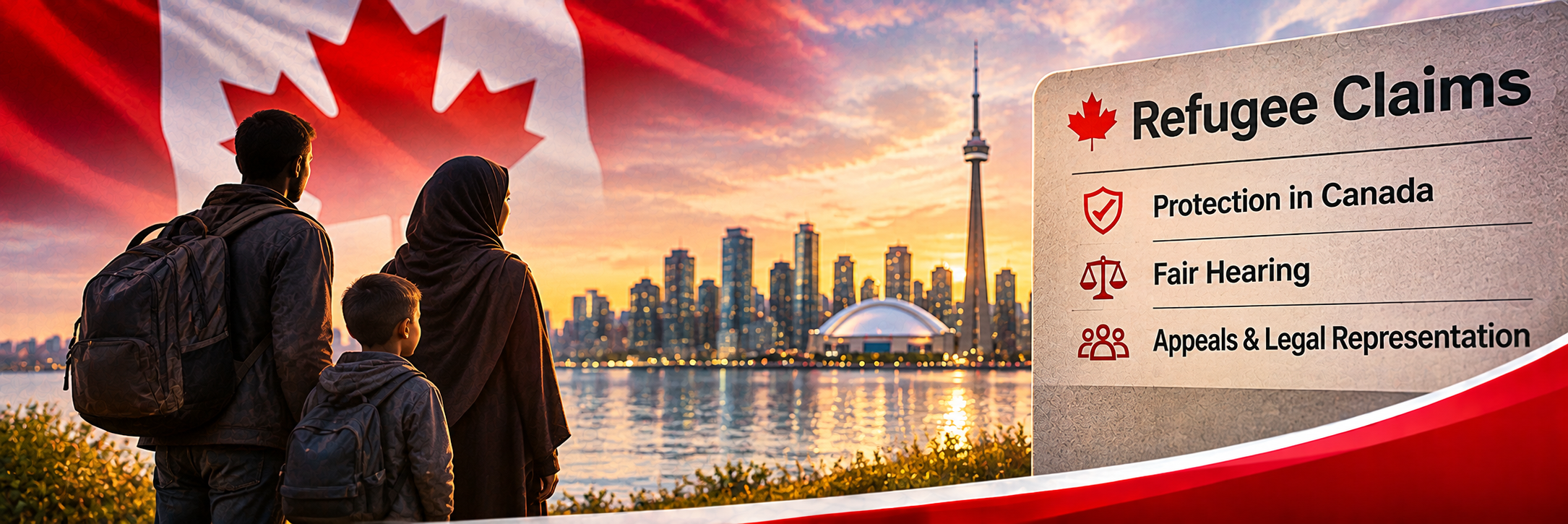
Refugee Claims in Canada
Seeking Protection in Canada? We Can Help You Understand Your Options.
Canada provides refugee protection to individuals who cannot safely return to their home countries because of persecution, torture, risk to their lives or other forms of serious harm.
If you fear returning to your country because of your political beliefs, religion, ethnicity, nationality, membership in a particular social group or other serious circumstances, you may be eligible to seek refugee protection in Canada.
Making a refugee claim is an important legal process that requires careful preparation, accurate documentation and a clear explanation of why you cannot safely return to your home country.
At Neon Law Professional Corporation, we assist individuals and families seeking refugee protection in Canada. Our team helps clients assess their circumstances, prepare their refugee claims, organize supporting evidence and navigate proceedings before the Immigration and Refugee Board of Canada (IRB).
We understand that sharing personal experiences of persecution, threats and violence can be difficult. We approach every case with care, professionalism and attention to the individual circumstances of each claimant.
What Is a Refugee Claim?
A refugee claim is an application for protection made by an individual who fears returning to their country of nationality or, in certain circumstances, their country of former habitual residence.
Canada recognizes two main categories of persons who may qualify for refugee protection:
1. Convention Refugees
A Convention refugee is a person who has a well-founded fear of persecution based on one or more of the following grounds:
- Race: Persecution because of ethnicity, colour or racial background.
- Religion: Persecution because of religious beliefs, practices or lack of religious beliefs.
- Nationality: Persecution because of citizenship, national identity or membership in a particular ethnic or national group.
- Political Opinion: Persecution because of actual or perceived political beliefs or opinions.
- Membership in a Particular Social Group: Persecution because of characteristics such as gender, sexual orientation or other recognized social group characteristics.
To qualify, the individual must generally demonstrate that they are unable or, because of their fear, unwilling to seek protection from their country.
2. Persons in Need of Protection
A person in need of protection is someone who may not meet the Convention refugee definition but faces a serious risk if returned to their country.
This category may apply where there are substantial grounds to believe that the individual would face:
- A danger of torture.
- A risk to their life.
- A risk of cruel and unusual treatment or punishment.
The risk must meet the requirements of Canadian immigration law and generally must be one that is not faced generally by other individuals in the country or that arises from inadequate state protection, as applicable.
Who May Make a Refugee Claim in Canada?
Individuals physically present in Canada may be able to seek refugee protection, either when entering Canada at a port of entry or by making a claim from within Canada.
However, not everyone is eligible to have their claim referred to the Refugee Protection Division (RPD).
Eligibility restrictions may apply in circumstances involving:
- Previous refugee claims in Canada.
- Previous refugee claims in another country.
- Recognition as a refugee by another country where the person can return.
- Certain criminality or security-related grounds.
- Certain inadmissibility findings.
- The Safe Third Country Agreement with the United States.
- The new statutory time limits for making certain asylum claims.
These restrictions are important and should be assessed before submitting a claim.
Important: New Refugee Claim Eligibility Rules
Canada introduced significant changes to its asylum system in 2026.
Under the new rules, certain claims are ineligible for referral to the IRB if:
- The individual entered Canada after June 24, 2020, and makes a refugee claim more than one year after their first entry, regardless of subsequent departures and returns.
- The individual entered Canada irregularly between ports of entry along the Canada-US land border and makes a claim more than 14 days after that entry.
Certain exceptions apply, including for unaccompanied minors and other prescribed circumstances.
These rules are particularly important for individuals who have been living in Canada for an extended period before deciding to make a refugee claim.
If you are considering making a refugee claim, obtaining legal advice about eligibility before submitting your application is essential.
How to Make a Refugee Claim in Canada
There are generally two ways to initiate a refugee claim.
1. Making a Claim at a Port of Entry
Individuals arriving in Canada may request refugee protection from a Canada Border Services Agency (CBSA) officer at an airport, land border or other designated port of entry.
The officer conducts an initial examination and assesses whether the claim may be referred to the IRB.
Applicants may be required to provide identification documents, travel history and information about the reasons they fear returning to their home country.
2. Making a Claim From Within Canada
Individuals already in Canada may initiate a refugee claim through the applicable Immigration, Refugees and Citizenship Canada (IRCC) process.
As of November 3, 2026, the refugee claim process includes updated online application requirements, including the submission of Basis of Claim information through the IRCC Portal.
IRCC reviews the application to determine whether the claim is eligible for referral to the IRB.
The exact process and requirements may depend on when and how the claim was initiated.
What If Your Refugee Claim Is Refused?
A negative decision does not necessarily mean that all legal options are exhausted.
Depending on your circumstances, you may have access to one or more of the following remedies.
1. Refugee Appeal Division (RAD) Appeal
Eligible claimants may appeal a negative RPD decision to the Refugee Appeal Division of the IRB.
The RAD reviews the decision and may consider errors of fact, law or mixed fact and law.
Depending on the circumstances, the RAD may:
- Confirm the RPD decision.
- Set aside the decision and substitute its own determination.
- Refer the matter back to the RPD for reconsideration.
Certain claimants are excluded from the RAD appeal process under the applicable legislation.
2. Federal Court Judicial Review
If a claimant is not entitled to a RAD appeal, or after an applicable appeal process has been exhausted, judicial review may be available before the Federal Court.
Judicial review examines whether the decision was reasonable and whether the decision-making process was procedurally fair.
It is not a new refugee hearing or an automatic reconsideration of the evidence.
3. Pre-Removal Risk Assessment (PRRA)
In certain circumstances, individuals facing removal from Canada may be eligible to apply for a Pre-Removal Risk Assessment.
A PRRA examines whether the individual would face persecution, torture, risk to life or cruel and unusual treatment or punishment if removed to their country.
Eligibility and timing restrictions apply, including restrictions arising from previous refugee proceedings.
How Neon Law Can Help
At Neon Law Professional Corporation, we understand the importance of preparing a strong and properly documented refugee claim.
Our services include:
- Initial refugee claim eligibility assessments.
- Refugee claim preparation and submission.
- Basis of Claim preparation and review.
- Assessment of Convention refugee and person-in-need-of-protection grounds.
- Country condition research.
- Collection and organization of supporting evidence.
- Preparation of affidavits and witness statements.
- Refugee hearing preparation.
- Representation before the Refugee Protection Division.
- Refugee Appeal Division appeals.
- Federal Court judicial review.
- Pre-Removal Risk Assessment applications, where appropriate.
We approach each case individually, taking the time to understand the claimant’s experiences, concerns and reasons for seeking protection.
Our objective is to present your circumstances clearly, accurately and in accordance with Canadian refugee law.
Frequently Asked Questions
Q: Who qualifies for refugee protection in Canada?
A: Individuals who meet the definition of a Convention refugee or person in need of protection may qualify. They must demonstrate that they face the relevant persecution or serious risk if returned to their country.
Q: Can I make a refugee claim if I am already in Canada?
A: Yes. Individuals physically present in Canada may be able to initiate a refugee claim through IRCC, subject to eligibility requirements and statutory restrictions.
Q: Can I make a refugee claim if I entered Canada on a visitor visa?
A: Yes, potentially. Having entered Canada on a visitor visa does not automatically prevent you from making a refugee claim. However, the new one-year eligibility restriction and other applicable rules must be considered.
Q: Can I make a refugee claim if I have a work or study permit?
A: Yes, potentially. Temporary resident status does not automatically prevent someone from seeking refugee protection.
Q: Can I include my spouse and children in my refugee claim?
A: Eligible family members may be included in a claim, depending on their circumstances and applicable requirements.
Q: Can I work while my refugee claim is being processed?
A: Eligible refugee claimants may apply for a work permit, subject to applicable requirements.
Q: What happens if I do not have documents proving persecution?
A: A refugee claim does not necessarily require official documentation for every incident. Your testimony, credibility, personal circumstances and other available evidence may be considered.
Q: How long does the refugee claim process take?
A: Processing times vary depending on the eligibility assessment, the complexity of the claim, hearing availability and other circumstances.
Q: Can I appeal if my refugee claim is refused?
A: Depending on your circumstances, you may be eligible to appeal to the Refugee Appeal Division or seek judicial review before the Federal Court.
Q: How long do I have to appeal a refugee refusal?
A: Generally, you have:
- 15 days from receiving the written RPD decision to file a Notice of Appeal with the RAD.
- 45 days from receiving the written decision to submit the Appellant’s Record.
Strict deadlines apply, and eligibility for an appeal must be assessed individually.
What happens if I miss my refugee hearing?
If you fail to attend your hearing, the RPD may initiate abandonment proceedings. You should obtain legal advice immediately if you cannot attend or have missed a scheduled hearing.
Seeking Refugee Protection in Canada?
Leaving your home country because of persecution, threats or serious danger is an extremely difficult experience. Understanding your legal rights and preparing your refugee claim properly can make an important difference.
At Neon Law Professional Corporation, we assist individuals and families seeking protection in Canada. From initial eligibility assessments to refugee hearings, appeals and Federal Court proceedings, our team provides legal guidance throughout the process.
Contact Neon Law Professional Corporation today to discuss your refugee claim.
Legal Disclaimer: The information on this page is provided for general informational purposes only and does not constitute legal advice. Refugee protection eligibility and procedures depend on individual circumstances and applicable immigration legislation. No particular outcome is guaranteed.